
The support, maintenance and modernization of these host applications, especially in the COBOL environment, requires in-depth technical and programming knowledge. Legacy applications are almost always an evolved mixture of programs, databases, interfaces, middleware and other components. In many cases, very complex IT infrastructures have developed over decades, consisting of countless sub-applications. These are predominantly programmed in COBOL, a language that has been established since the 1950s and was developed specifically for business-critical applications. It may therefore come as no surprise that the required specialist knowledge of COBOL and the intricacies of such hosts is rapidly declining, making it increasingly difficult to further develop or even modernize such applications at the required pace. This is due to both the loss of experienced and highly qualified IT experts in companies and the lack of qualified junior staff. However, many companies are still reluctant to migrate their business-critical host workloads to the cloud, for example, and replace their legacy systems in order to become more agile and customer-friendly. The risk of migration errors, very long migration periods and expected system downtimes, as well as the almost non-existent know-how about the old processes, is too great. All these criteria can make such a migration considerably more difficult and, in the worst case, even threaten the existence of the company.
This is precisely where our experienced mainframe team comes into play and supports you as a competent modernization partner for your legacy systems. We support you in maintaining the functionality of your host infrastructure in the long term.

Mainframe modernization: We are your reliable partner
The mainframe, also known as the mainframe or host, is still used by numerous companies, many of which run their applications on a COBOL basis in order to operate their business-critical core applications in a highly available and stable manner. Reliability, scalability, compatibility and access protection have always been the key performance features of a host. Companies such as banks, insurance companies, retailers, energy suppliers and the public sector in particular are therefore still relying on the great strengths of the mainframe. Another is that it processes large volumes of data highly efficiently and securely. The use of these COBOL-based applications, some of which have grown over decades, brings with it complex challenges in terms of maintenance, servicing and modernization.
Expertise for COBOL-based host environments is in short supply
Keep your mainframe environment up to date - with our expert knowledge
We support you in the maintenance and further development of your COBOL-based application systems in the mainframe environment so that you can ensure the stable operation of your business-critical IT systems. Our experienced mainframe team is characterized by special and long-standing experience in the development and maintenance of systems and applications for IBM mainframes and comparable computer platforms. Our IT professionals have in-depth experience in the further development, maintenance and migration of host applications in COBOL and PL/1. Rely on our expert knowledge and compensate for the loss of long-standing employees and the lack of new talent. Together, we ensure that your hosts are always up to date and can also reliably meet new requirements.

Adapting hosts to legal and regulatory requirements - we know how
The topic of compliance is by no means unknown, especially in highly regulated sectors such as the financial industry, the insurance industry, the energy industry and the public sector. Constant change and the complexity of business transactions are increasingly presenting banks, insurers, energy suppliers and public authorities with the challenge of having to adapt their compliance structures and regulations in an agile and continuous manner. For companies that use complex, individualized host systems, this is a task that needs to be approached with care and experience.
It requires experienced programmers and IT experts who can specifically identify any risks and weak points in the host environment and modernize the necessary sub-applications, while always keeping an eye on the stability of the entire IT infrastructure. However, our experienced mainframe team is not just made up of programmers who know exactly what they are doing and can reliably maintain and service your mainframes. Our experienced COBOL IT professionals speak fluent German throughout – a feature that can pay off for you in particular.

Our IT professionals are fluent in German
In view of the fact that the majority of program code written in the host environment was written by German developers around 40 years ago, we have experienced in numerous projects that the topic of “language” is a key success factor for really finding your way around highly complex program code. Close communication with the specialist departments about process and business workflows is also essential for us. In addition, legacy systems that have grown over decades rarely have consistent documentation, and in those subsystems where this is the case, variables, abbreviations and comments are written in German. Companies that rely on nearshoring or offshoring often quickly reach their limits with COBOL applications, as language barriers make it considerably more difficult to analyze old program parts. Rely on the many years of expertise of our IT professionals and reliably adapt your hosts to current requirements on the basis of our comprehensive IT and programming know-how. Our dedicated and highly motivated IT professionals work regionally independently and, if required, throughout Germany. This is made possible by our remote deployment.
Efficiently maintain or replace legacy systems
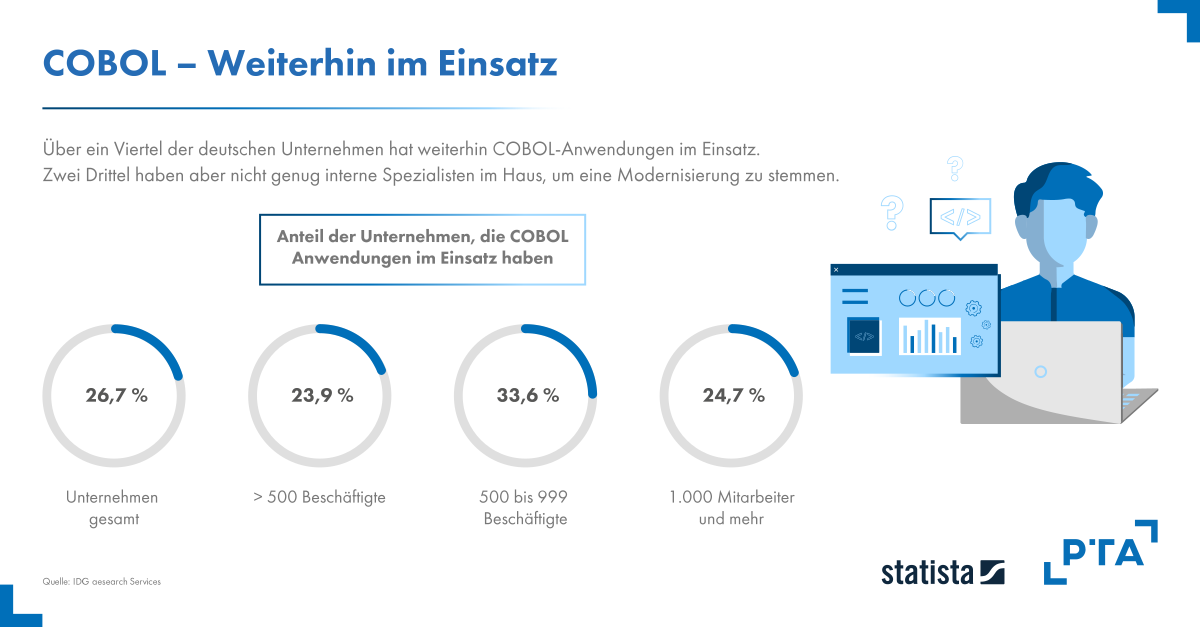
Around a quarter of German companies still use COBOL applications today. This is shown by the market analysis that we initiated together with Statista. The programming language, which was created in the early days of computer development at the end of the 1950s, is still used today primarily for commercial applications. However, this situation now poses major challenges for many IT managers: Maintaining such legacy systems is not only time-consuming and expensive. Many companies lack the internal COBOL know-how to initiate maintenance, further development or modernization. Regardless of whether you are looking for specialists who can reliably support you in the maintenance and servicing of your legacy systems or provide you with advice and assistance when replacing old IT landscapes: Our consultants are not only technically proficient in COBOL, but also in the context of modern migration and integration scenarios, and will accompany you competently on the way to a future-proof and digital IT landscape.
Convince yourself of our wide-ranging expertise
So that you can convince yourself of the range of IT know-how and programming knowledge of our host experts, we present here a small excerpt from our project database of some of our mainframe projects:
Project ID: 5205
Premium adjustment and product support in health insurance
Project ID: 4102
Maintenance and further development of an actuarial application
Project ID: 5478
Maintenance and further development of a legacy application (host legacy, PL/1, C)
Project ID: 5477
Migration of a legacy application (host legacy, PL/1, C) to SAP
Project ID: 5776
Maintenance and further development of a legacy application
Project ID: 6111
Implementation of the life insurance interface to the digital pension overview
Important questions about mainframe and COBOL
What is COBOL?
COBOL (Common Business Oriented Language) is a programming language that was developed at the end of the 1950s specifically for business applications. It is still used today by many companies, particularly in the banking, insurance and administration sectors, to operate reliable, secure and long-lasting software solutions.
Why do companies still use mainframes today?
Many companies continue to use mainframes, as these mainframes meet particularly high requirements in terms of reliability, stability, data security and scalability. Industries such as banks, insurance companies and energy suppliers in particular rely on mainframes to process large and business-critical data volumes.
What challenges arise when maintaining legacy systems based on COBOL?
The biggest challenges include an increasing lack of experienced COBOL experts who can maintain and further develop complex applications that have often evolved over decades, as well as a lack of documentation and know-how about old processes, which makes modernization more difficult.
How does PTA support companies with mainframe modernization?
PTA offers extensive expertise in the maintenance, servicing and modernization of mainframe and COBOL-based applications. Our specialists ensure that your legacy systems are always kept up to date, provide support during migrations and help you to adapt your host environment to new requirements and regulatory specifications.
Why are German language skills often crucial when maintaining legacy systems?
Many older COBOL programs contain comments, variables and documentation in German, as they were originally written by German-speaking developers. German language skills are therefore often crucial in order to quickly and safely familiarize yourself with existing source codes and business processes.
Contact now
Contact now
Download file
