

A collaboration between PTA and Statista
This blog series provides the latest figures, trends and forecasts on the use of AI technologies in companies. With fact-based findings, we provide well-founded insights to make the latest advances in AI understandable and tangible. The series is produced in cooperation with Statista.
Agentic AI can effectively complement existing IT landscapes – especially where historically grown systems set the pace. Our series shows high strategic and operational potential. Now it’s time to focus on the practical side of things: where exactly is support needed for agents to move from pilot to everyday use? We also explored this question in the study “Agentic AI in practice“, for which 200 IT decision-makers were surveyed. The key findings are discussed in more detail below.
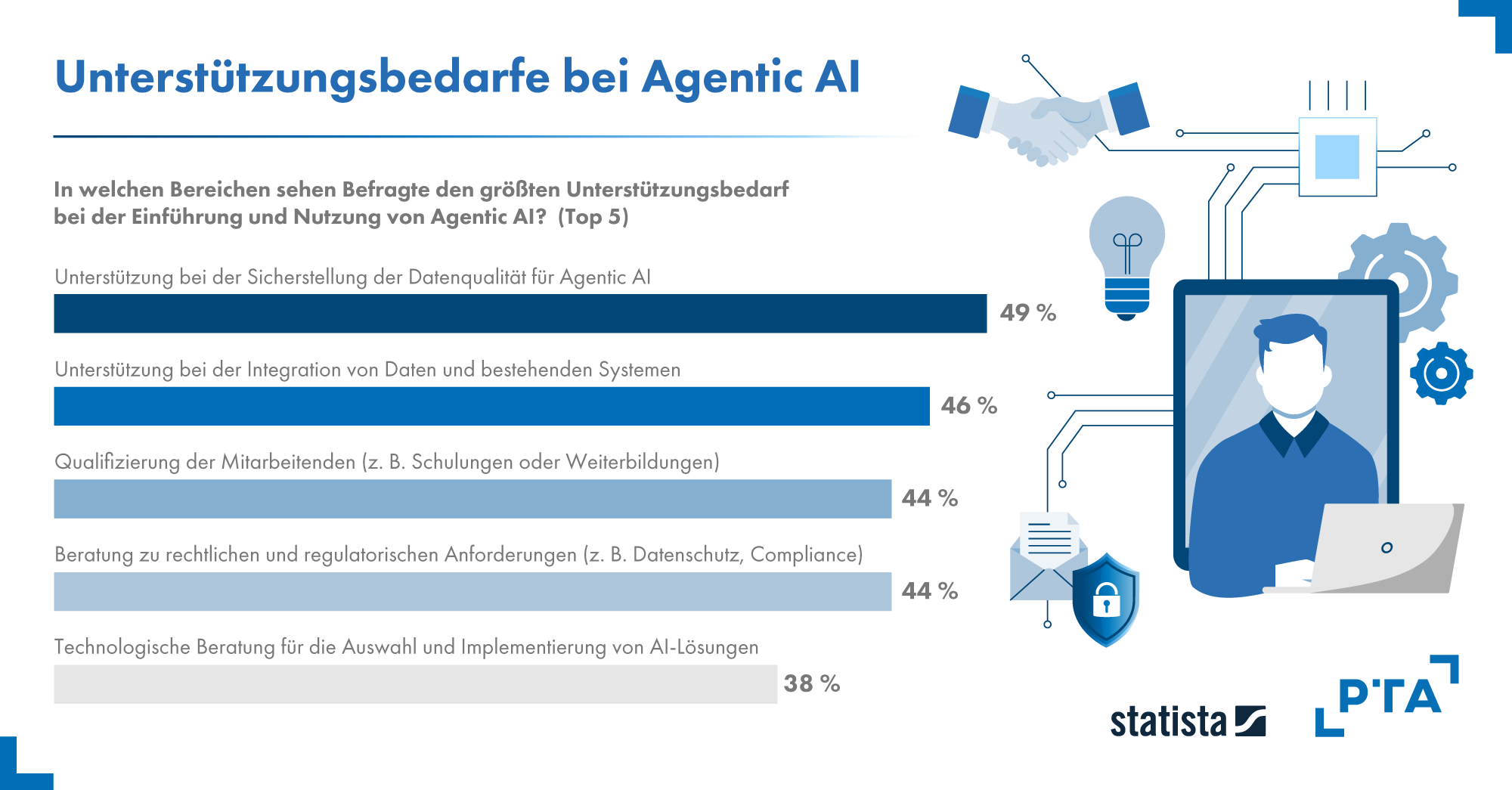
Data quality & integration
Reliable workflows cannot be created without a reliable database and connected systems. In brownfield environments, information is distributed across documents, databases and logs. One solution for this is RAG (Retrieval-Augmented Generation), which can be used by AI agents as an integration layer: Relevant content is retrieved, put into context and made usable for decisions.¹,² This reduces friction without the need for a complete replacement of legacy systems. At the same time, international studies show that data access and quality are key prerequisites for making AI scalable.3,4,5
Skills, Enablement & Change
Agentic AI is not just a tool project. To build up the necessary knowledge, teams need practical training and workshops with use cases in order to adopt new processes with confidence. Studies show that scaling success occurs where workflows are redesigned and governance roles are anchored – not just by adding a model.
Governance, law & security
As soon as agents become active on their own, clear rules are needed: Who is allowed to do what? Which steps require human approval? And what is logged (audit trail)? Frameworks such as AI TRiSM (Artificial Intelligence Trust, Risk, and Security Management) help to manage governance, risks and security in a structured manner.6,7 The OECD’s AI principles also promote trustworthy, traceable AI.8
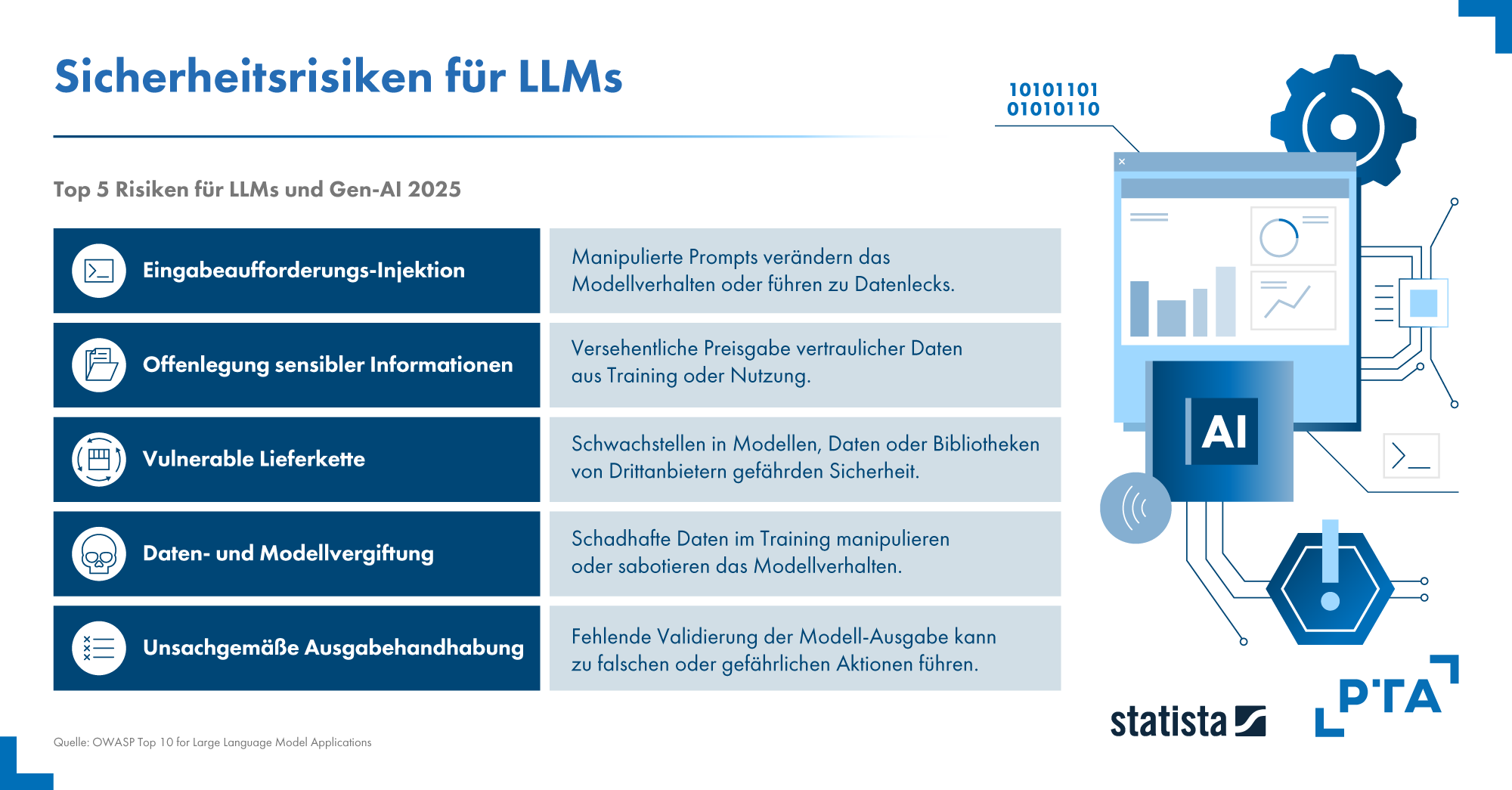
The need for security grows with every additional company data set that agents access. The Open Worldwide Application Security Project’s top 10 warnings for LLM applications include prompt injection, data poisoning and too much autonomy – including specific countermeasures.9
Selection and implementation of AI solutions
Technological consulting helps to select the right solution from the flood of tools – tailored to the objectives, data situation and risks. It clarifies the architecture of the AI agents at an early stage, plans integration into existing systems, establishes security and data protection (roles, approvals, protocols) and carries out comparative tests with real data. This creates a pilot with clear KPIs and stable operation, which can then be rolled out step by step without having to change everything at once.
¹ Microsoft LearnRAG and generative AI – Azure AI Search (architecture overview & role of the retrieval layer)
² Lewis et al. (2020): Retrieval-Augmented Generation for Knowledge-Intensive NLP Tasks (basic paper)
³ McKinsey “The State of AI” (2024/2025): Data, workflow redesign and roles as levers of value realization
⁴ Gartner “Data & Analytics 2025” (2025): Data quality remains a key barrier to scaling AI initiatives
⁵ OECD “Enhancing Access to and Sharing of Data in the Age of Artificial Intelligence” (2023/2024): Data access and quality as the key to scalable AI use. Organization for Economic Co-operation and Development (OECD)
⁶ Gartner“AI Trust, Risk and Security Management (AI TRiSM)” – Governance/Risk Management for AI
⁷ (Classification) AvePoint summary on the Gartner-TRiSM Report 2025
⁸ OECD AI Principles – International reference framework for trustworthy AI
⁹ OWASP Top 10 for Large Language Model Applications – Most common security risks & countermeasures