

A collaboration between PTA and Statista
This blog series provides the latest figures, trends and forecasts on the use of AI technologies in companies. With fact-based insights, we provide well-founded insights throughout the year to make the latest advances in the field of AI understandable and tangible. The series is produced in cooperation with Statista.
Articles, videos, images – AI-generated content is flooding the web and is almost indistinguishable from content created solely by human hands. Generative Artificial Intelligence (Gen AI) has arrived in the mainstream. But despite the wide-ranging fields of application, Gen AI remains a tool that only reacts and does not generate any output without user input.
But what would be the potential of an AI that proactively and autonomously performs its task and constantly improves in the process? For example, such an AI could recognize cyber attacks, actively fend them off and be even better prepared for future attacks based on the experience gained. The use of such AIs would also be conceivable in customer service. They could process customer inquiries and independently solve problems for customers, such as arranging refunds. This type of AI is known as agentic AI.
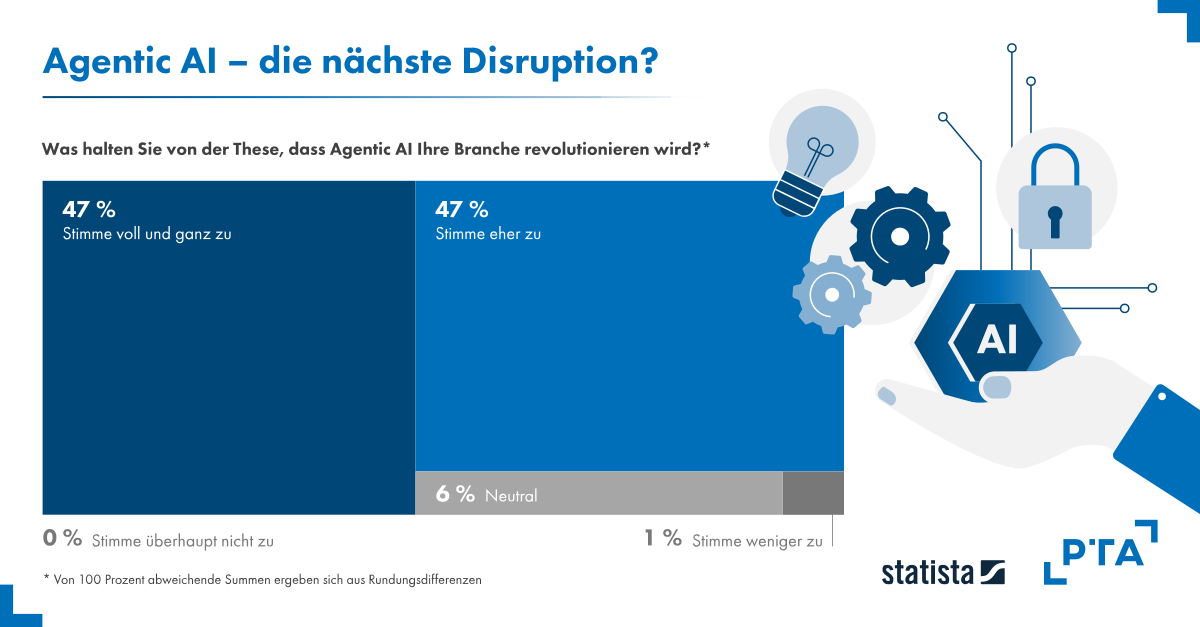
Companies are already recognizing the huge potential: 94% of respondents are convinced that Agentic AI will revolutionize their industry¹. This is the result of a survey of 100 corporate decision-makers and 100 IT decision-makers in Germany, which was conducted in cooperation with Statista.
Differences between Generative AI and Agentic AI
| Feature | Gene AI | Agentic AI |
|---|---|---|
| Target | Creates content (text, images, code, etc.) | Pursues goals |
| Decision-making | Reactive (reacts to input) | Proactive (plans and acts autonomously) |
| Autonomy | Requires user input to generate outputs | Can act independently with minimal supervision |
| Example customer service | Generates texts for emails to customers, based on user input | Independent customer communication and problem solving |
How does Agentic AI work?
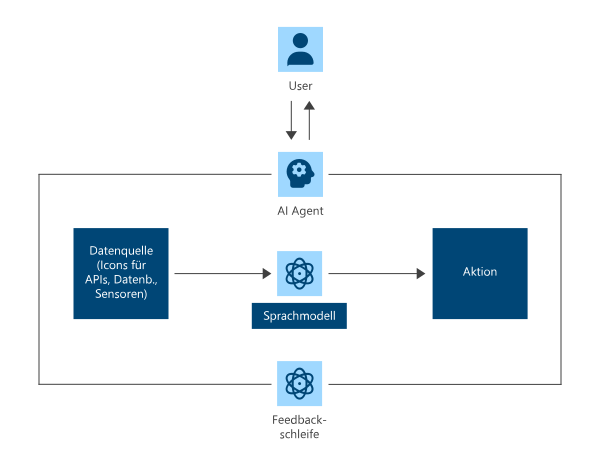
Agentic AI uses a four-stage iterative process to achieve its goal and solve problems:
Perception: The AI collects and processes data from various sources, e.g. sensors, databases or digital interfaces.
Thinking: A large language model (LLM) acts as a central control unit, understands tasks, develops solutions and coordinates other routines for specific functions such as a Gen AI to create content to match the task.
Act: By integrating with external tools and software via APIs, Agentic AI can quickly execute tasks based on their plans. AI agents can also be equipped with guardrails to ensure that they complete tasks correctly.
Learning: The AI constantly improves itself with the help of a feedback loop. Collected interaction data is used to optimize the AI’s approach.
As much potential as fields of application
99% of respondents expect strategic and operational benefits from Agentic AI for their company¹ – across all industries. This is hardly surprising, as the number of possible fields of application is enormous.
In medical image analysis, for example, CT scans or X-rays can be analyzed independently by AI agents. The AI can recognize anomalies and suggest diagnoses that become increasingly accurate through continuous learning.
Agentic AI can also help companies save costs and increase efficiency in logistics. For example, through the real-time analysis of supply chains, which takes into account variables such as traffic jams, weather conditions and fuel costs, with subsequent autonomous route optimization. For companies to make the most of such potential, the support of AI consultants is crucial. These experts help to develop the right strategies for implementing agentic AI.
Agentic AI: Preparing for future technologies at an early stage
Agentic AI is still at the very beginning of its development. However, its wide range of potential applications make it one of the most exciting innovations in the field of artificial intelligence. Companies that are now actively involved in the development of Agentic AI can build up in-depth knowledge and are thus optimally prepared to adapt future technological developments at an early stage. This is because Agentic AI will have a significant impact on how companies operate, communicate and secure competitive advantages in the near future.
¹ Agentic AI Report PTA (2025)