

A collaboration between PTA and Statista
This blog series provides the latest figures, trends and forecasts on the use of AI technologies in companies. With fact-based findings, we provide well-founded insights to make the latest advances in AI understandable and tangible. The series is produced in cooperation with Statista.
After generative AI comes AI agents in the company: autonomous, targeted systems that can act and make decisions without user input or monitoring.
While generative AI continues to be used by many people as a creative tool, AI agents are taking automation and the optimization of individual processes to a new level. They are able to make decisions and perform more complex tasks in real time. The special feature: The systems make decisions independently and without the need for human intervention.
As a result, many users are already recognizing the enormous potential of Agentic AI for companies – and not just in individual applications, but also at a broad operational and strategic level. But which potentials stand out in particular? And what difference does the size of the company make here?
Strategic advantages at a glance
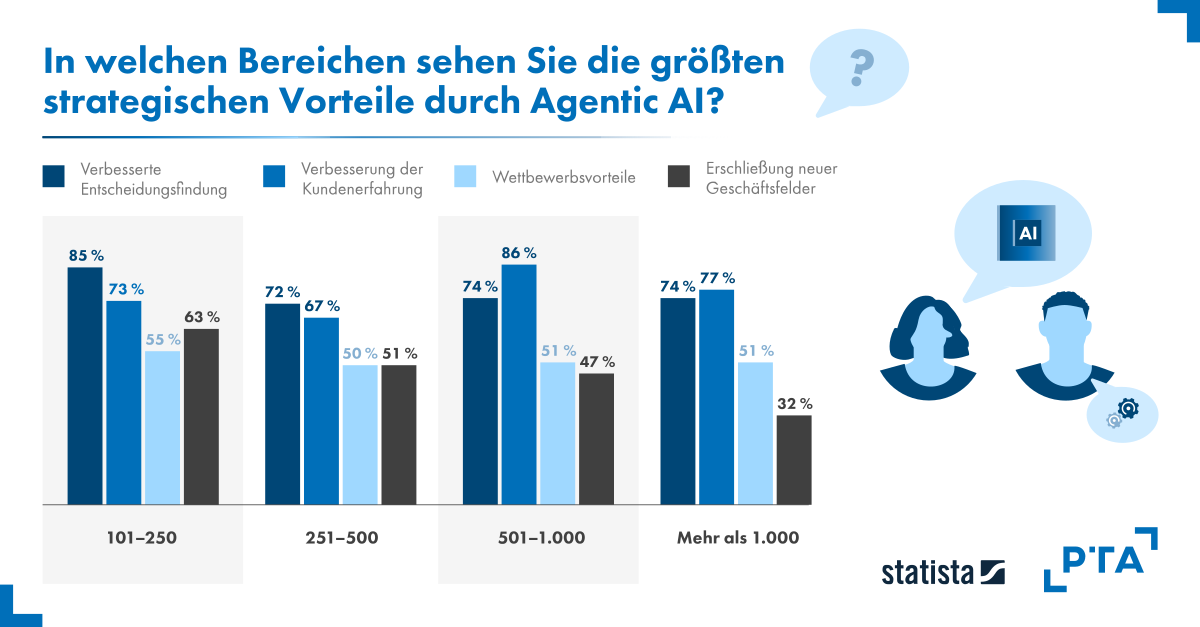
Above all, companies associate Agentic AI with the hope of data-based decisions and an improved customer experience:
- Improved decision-making: 85% of respondents (in companies with 101-250 employees) see key potential here. Larger companies (over 1,000 employees) also confirm this added value at 74%. The positive effects can be explained, among other things, by the fact that the use of Agentic AI makes it possible to use real-time data within the company. This creates the basis for well-founded decisions, on the basis of which it is usually no problem to increase efficiency.
- Customer experience as a differentiator: Medium-sized companies (501-1,000 employees) in particular emphasize the relevance of customer orientation (86%). With the help of the relevant technology and AI-driven solutions, it is easier for companies to improve the customer experience for their target group and thus increase customer satisfaction. In times of increased competition, this is a clear advantage.
- Competitive advantages & new business areas: While smaller companies (101-250 employees) recognize the potential for innovation (63%), larger companies are more reserved in their assessment (only 32%).
What is striking is that smaller and medium-sized companies appear to be more active than large corporations when it comes to the strategic leverage of Agentic AI. Possibly because they can react more agilely to new technologies or are looking for differentiation and new growth areas in a more targeted manner.
The survey also shows that smaller companies with between 101 and 250 employees see Agentic AI primarily as a means of gaining a competitive advantage.
Operational effects: Where Agentic AI is changing everyday life for companies
Companies, especially medium-sized and large ones, also see enormous opportunities in Agentic AI at an operational level:
- Automation and efficiency: Companies with 501 or more employees see clear benefits here (approx. 70%), for example through process automation or IT efficiency.
Example: A company decides to have orders and customer inquiries processed automatically with the help of Agentic AI and to integrate the corresponding options into its e-commerce area. This reduces the processing time. At the same time, employees are confronted with less manual effort. - Employee relief: In large companies (over 1,000 employees), 75% state that Agentic AI can relieve them of repetitive tasks. This is a decisive lever for reducing the workload of the workforce and can be a competitive advantage in times of massive skills shortages.
Example: Companies that focus on the financial sector can use Agentic AI to analyze their monthly financial statements. This type of outsourcing allows employees to focus on other areas. For example, they have more time for strategic tasks. - Cost and resource efficiency: Companies with 501 to 1,000 employees in particular emphasize the importance of Agentic AI for companies to reduce costs (63%) and conserve resources (33%).
Example: Based on Agentic AI, it is possible to optimize supply chains and the processes associated with them. Companies can use the corresponding tools to adjust stock levels as flexibly as possible when required and avoid overstocking. This is precisely what prevents excessive storage costs.
While smaller companies primarily benefit from efficiency gains on a selective basis, larger companies are increasingly considering agentic AI as part of their comprehensive digitalization strategies. The AI agents are thus becoming “invisible colleagues” in the company that monitor processes, reduce errors and can intervene in real time if necessary.
In terms of operational benefits, it is clear that larger companies with more than 501 employees primarily use Agentic AI to automate processes and increase the efficiency of their IT. Smaller companies, on the other hand, are more interested in focusing on the potential relief of their employees when it comes to performing repetitive tasks.

What makes AI agents so unique?
It’s no secret that AI is evolving. And what was perhaps considered “unimaginable” a few years ago has now become a reality in many companies. Anyone dealing with precisely these further developments can no longer avoid AI agents.
They are a further development that not only specializes in the analysis of data and the recognition of patterns, but also goes one step further. The AI agents can make decisions autonomously. Accordingly, they are able to complete even complex tasks on their own, take responsibility and evaluate data in real time. At the same time, they can adapt and continue to optimize themselves. And it is precisely these aspects that make AI agents ideal partners for companies that want to outsource processes and relieve their employees.
Industry examples for Agentic AI & AI agents: Where are the solutions being used?
The use of Agentic AI and AI agents is not tied to any specific industry. The extensive possibilities ensure that these solutions can be used in many different areas of application.
The following table lists some examples:
| The trade | Companies that want to stand out from the competition are now increasingly focusing on personalized shopping experiences. AI agents are able to analyze the customer experience and develop marketing campaigns based on this. In addition to this, they can optimize stock levels in the warehouse and logistics to ensure more efficient operations. |
| The logistics area | Many freight forwarders are always on the lookout for ways to avoid empty runs and save money. AI agents can also help here – especially when it comes to avoiding or identifying errors in the supply chain. |
| In the insurance industry | AI agents can help the insurance industry to process reported claims and assess risks. They take over the analysis of insurance applications and damage reports and also support employees in processing each case more quickly. |
How can companies implement AI agents in a meaningful way?
It would certainly be wrong to assume that AI agents would inevitably always lead to greater effectiveness in the company. If you want to get the most out of your options, there are a few points to bear in mind. The following tips can help here:
- Companies should precisely define the goals and wishes that they associate with Agentic AI. Questions such as “Which areas do I want to automate?” play an important role here.
- It is also important to provide the AI agent with the right data. The systems can only be efficient if they can rely on reliable data.
- It also makes sense for a company that wants to work with an AI agent to remain flexible. The opportunities that arise with regard to scaling measures should not be underestimated under any circumstances. It is particularly “practical” in this context that Agentic AI is able to learn. This means that it can grow with the company that uses it.
What challenges are associated with the use of agentic AI and AI agents?
Anyone who takes a closer look at Agentic AI quickly realizes how extensive the possibilities are that the corresponding solutions offer. At the same time, however, there are some specific challenges to consider.
These include:
- Data quality: Clean, well-prepared and correct data forms the basis for working effectively with Agentic AI.
- High safety standards: As convenient as it is to rely on the work of an AI agent: The moment Agentic AI decides, humans relinquish some of their power. This makes it all the more important to set high safety standards from the outset.
- Employee training: It is important to focus on workshops and training courses and to integrate the team from the outset, also in terms of further education and employee training. It often turns out that AI workshops and similar offers can increase acceptance of the new possibilities.
For each of the challenges mentioned, comprehensive preparation and an examination of one’s own expectations can help to successfully implement AI agents – in both small and large companies.
Agentic AI for companies: Set the course now
Whether strategic or operational: from the company’s perspective, Agentic AI offers great potential at both levels. Companies that start pilot projects and build up expertise today will secure a clear competitive advantage in the long term. Because one thing is certain: after generative AI, AI agents in companies will be the next thing to permanently change working life. The future is agentic.