

A collaboration between PTA and Statista
The life science sector has a promising future ahead of it. The drivers of dynamic growth are the ageing population, technological progress and high levels of investment in research and development. However, market players must also overcome the challenges of digitalization and economic uncertainties in order to fully exploit their growth potential. Agentic AI, a new evolutionary stage of artificial intelligence, provides the life science industry with promising solutions. Companies in the life science sector are recognizing the value of Agentic AI – especially when it comes to automated diagnostics and laboratory processes. This specialist article shows which hurdles the growth industry has to overcome in the course of technological progress and which application scenarios achieve the greatest added value .
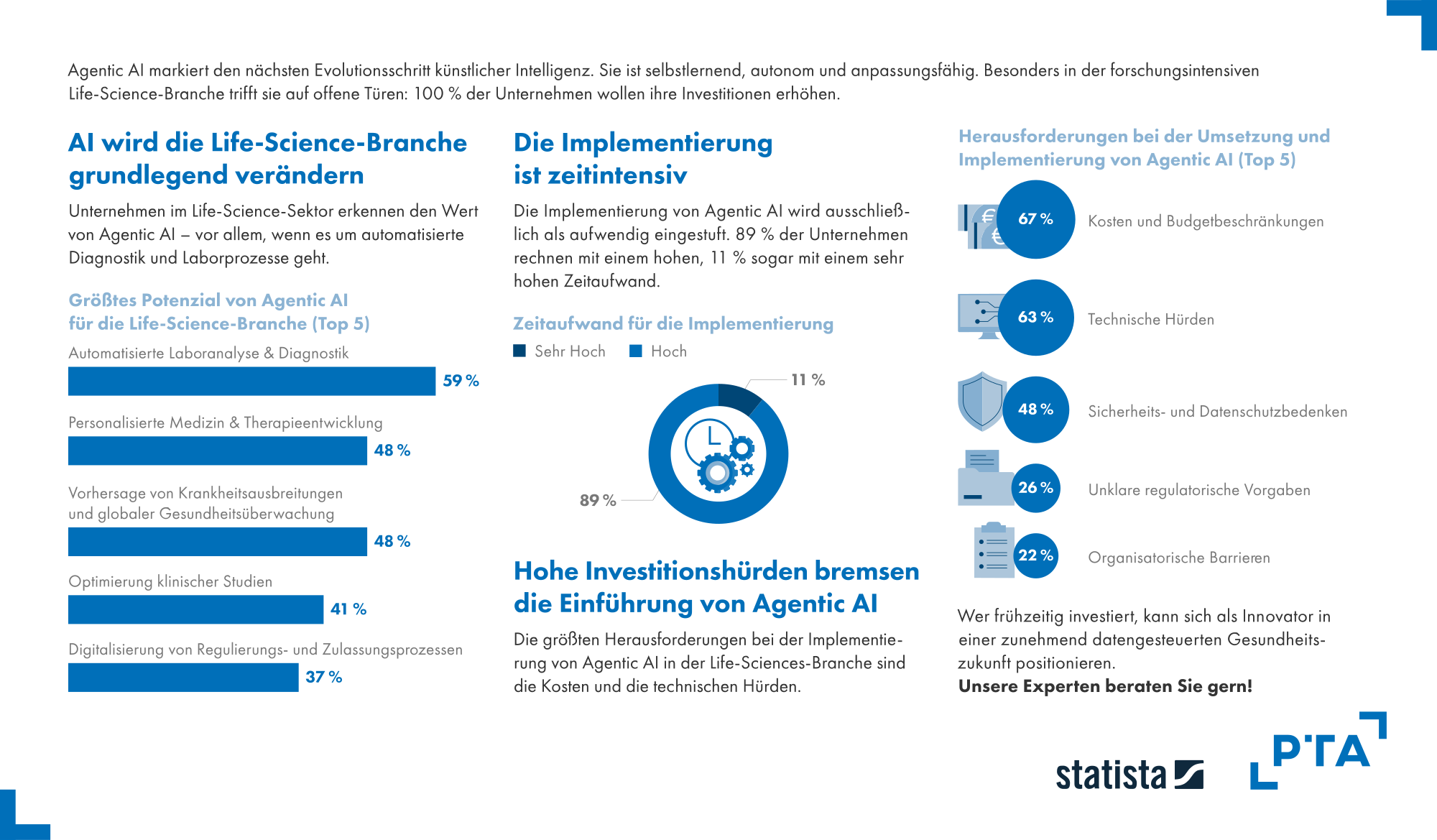
Agentic AI undoubtedly marks the next evolutionary step in artificial intelligence. It is self-learning, autonomous and adaptable. It is particularly popular in the research-intensive life science sector. So it may come as no surprise that in a survey conducted by our IT professionals together with market researchers from Statista, all of the companies surveyed from the life sciences sector want to increase their investments in the Agentic AI sector. Even if the use of agentic AI is still at an early stage in many companies: Those who invest early can position themselves as innovators in an increasingly data-driven healthcare market.
Diverse application scenarios …
In the life science industry, the automation of business-critical processes is a clear focus when it comes to agentic AI. A high degree of digitalization and the pressure to process large volumes of data quickly and in compliance with regulations necessitate the use of autonomous systems. 59% of the companies surveyed in this sector are convinced that the new technology will bring benefits in the automation of diagnostic procedures, such as image evaluation or high-throughput screening – in other words, in an area where processes that are highly modular, scalable and data-driven are predominant. This is where Agentic AI can create the basis for efficiency gains, standardization and risk minimization.
… between diagnostic evolution …
In the medical field, Agentic AI is therefore particularly useful for automating and accelerating complex analysis and diagnostic procedures. This is because Agentic AI recognizes anomalies more accurately through continuous learning in the form of feedback loops and can therefore make more precise diagnostic suggestions. In each case, 48% of the companies surveyed from the life sciences sector see great potential in Agentic AI in personalized medicine and therapy development as well as in predicting the spread of diseases and global health monitoring. Market players also consider the optimization of clinical studies (41%) and the digitalization of regulatory and approval processes (37%) to be promising fields of application.
… and implementation hurdles
The majority of respondents from the life science industry agree that the implementation of agentic AI cannot take place overnight: 100% expect the implementation and introduction of the new technology to take a long to very long time. Costs and budget restrictions (67%) and technical hurdles (63%) are the main challenges facing the industry. According to the companies surveyed, other stumbling blocks include security and data protection concerns (48%), unclear regulatory requirements (26%) and organizational barriers (22%). When it comes to support for the implementation of Agentic AI, they primarily rely on workshops with industry-specific application examples. However, standardized guidelines (52%) are also very welcome among life sciences companies, as they can provide support within the framework of predefined and standardized processes.
Agentic AI: The four-stage path to autonomous intelligence
Agentic AI is based on an iterative process that comprises four stages: perceiving, thinking, acting and learning. During perception, the new evolutionary stage of artificial intelligence collects and processes data from various sources, such as databases. The thinking process focuses on a large language model (LLM). This is responsible for developing tasks and solutions and for controlling routine processes, such as the use of generative AI to create content. Action is about the concrete execution of tasks based on previously created plans. External tools and software are integrated via digital interfaces for this purpose. Finally, the interaction data collected to date can be used in feedback loops to optimize Agentic AI. This allows it to continuously improve its approach. And it is precisely because of its functional structure that Agentic AI is of great value in complex laboratory environments in which processes are strictly regulated but are run through repeatedly – the keyword being automation.
Agentic AI – great potential, but not a sure-fire success
There is no question that agentic AI has great potential. Despite the early stage of development, the majority of German companies across all sectors are planning to increase their Agentic AI budgets over the next three years. The majority of decision-makers have apparently recognized that Agentic AI will revolutionize their industry – they expect to gain strategic and operational advantages by using the new technology. This is because the use of Agentic AI shifts the focus from pure content creation to autonomous action and decision-making. As a new evolutionary stage of artificial intelligence, Agentic AI will comprehensively change the existing structures of the business world. However, companies in the life sciences sector require external support in terms of both technology and personnel to achieve long-term success with agentic AI: 89% of companies expect a high level of time expenditure, 11% even a very high level. A trend that is also reflected in figures across all sectors: Most companies surveyed across all sectors see the greatest need for support in ensuring data quality (49 percent) and the integration of data and existing systems (46 percent). However, employee training (44%), advice on legal and regulatory requirements (44%) and technological advice on AI solutions (38%) are also areas in which support will be required. Without practical training and workshops with industry-specific application examples as well as personal advice or coaching from external experts, the successful introduction of Agentic AI will quickly become a Herculean task. Successful implementation therefore requires more than just technology: a clear understanding of the process, comprehensive automation readiness and high data quality are crucial. The key lies in small, practical steps, external support and organizational openness. Those who start early and take a strategic approach can then position themselves as pioneers.