

A collaboration between PTA and Statista
Agentic AI has ushered in the next stage of artificial intelligence: the new evolutionary stage of artificial intelligence proactively and autonomously performs its tasks and constantly improves completely autonomously. The insurance industry – the majority of decision-makers in insurance companies are certain of this – can use Agentic AI to implement promising solutions for the future. Agentic AI can make full use of its strengths, particularly in the optimization and automation of customer service and the reliable forecasting of risks. In addition to these great opportunities, however, there are also challenges that must not be ignored in the course of implementing these far-reaching technological innovations.
Artificial intelligence that controls work processes and makes decisions independently – what was still a dream of the future a few years ago is now a reality. However, although numerous companies are already active in the field of agentic AI, the complexity of the topic means that it is not a sure-fire success. As great as the opportunities offered by the use of modern technology approaches are, the challenges for companies to implement them are just as great. It is therefore not just the insurance industry that is at a turning point: in a competitive market, Agentic AI requires a balance between potential, effort and risk. In contrast to the more widespread Generative AI, Agentic AI is able to recognize process completions, carry out self-corrections if necessary and relinquish control in the event of errors. The focus thus shifts from pure content creation to autonomous action and decision-making. As a new evolutionary stage of artificial intelligence, Agentic AI has comprehensively changed the previous structures in the insurance industry. It is therefore necessary to systematically analyze and classify this new technology and adapt it to specific sectors. In this way, a differentiated view of potentials and risks as well as a structured orientation in dealing with Agentic AI can be created.
The majority of the insurance industry recognizes potential
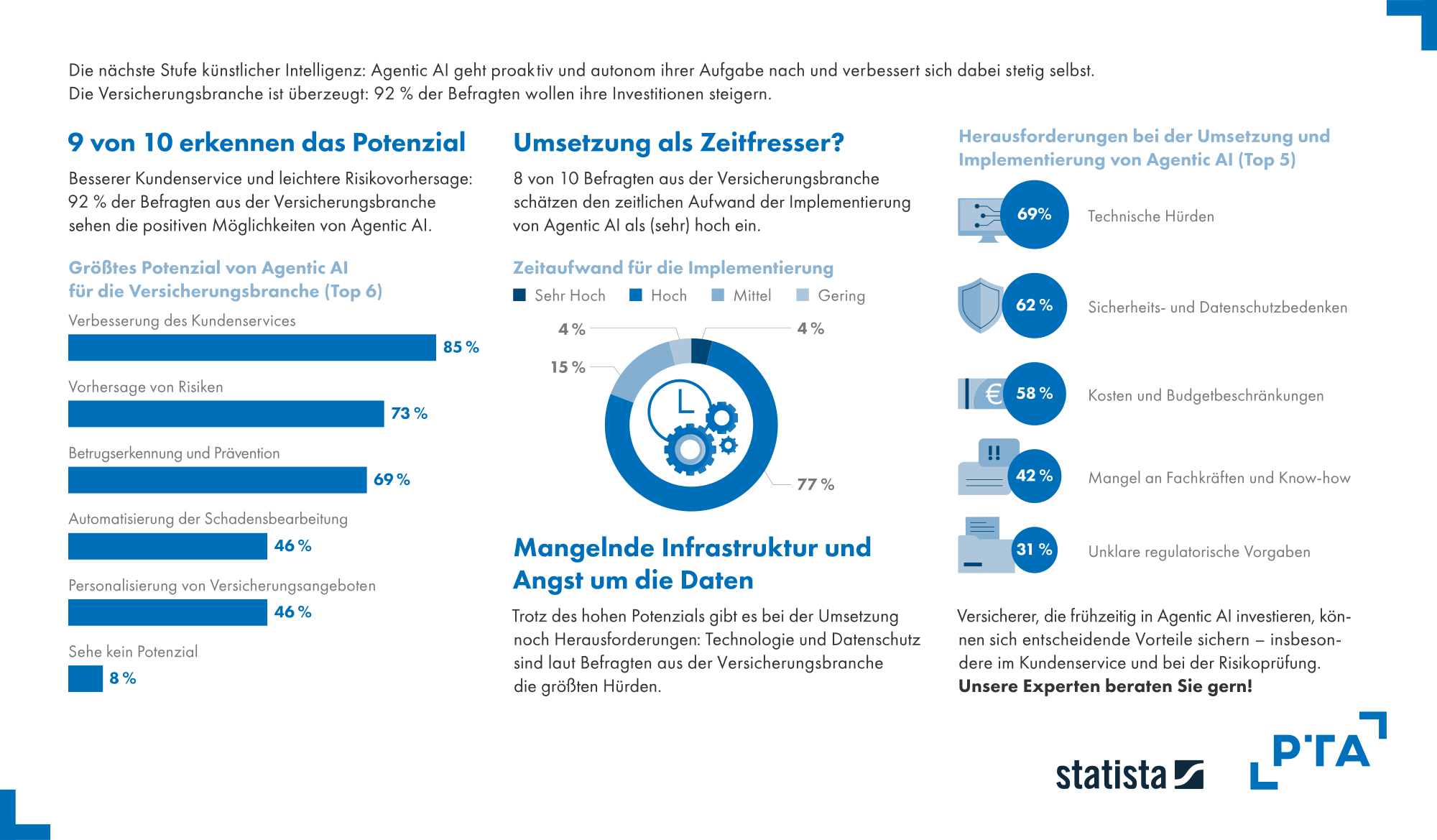
The great potential for transforming the insurance industry using agent-based AI and aligning it with the requirements of customers and the market is recognized by the vast majority of market players. This is shown by a survey conducted by our IT experts together with market researchers from Statista. According to the survey, 92% of respondents plan to increase their investments in order to anchor Agentic AI in their organizations. Insurers expect the greatest added value from the new AI technology to be the optimization and individualization of their customer service – 85% consider this objective to be a priority. This is closely followed by easier risk prediction. 73% of those surveyed believe that Agentic AI can provide valuable services, especially when it comes to reliable forecasts. Decision-makers in the insurance industry see further important areas of application for Agentic AI in the detection of attempted fraud and proactive prevention (69%) as well as in the automation of claims processing and personalization of insurance offers (46% each). Only 8% of the insurers surveyed stated that they did not see any market potential in Agentic AI.
Great potential meets complex implementation
Although the insurers surveyed identified numerous areas of application in which Agentic AI can provide relief, efficiency and a contemporary market presence, there are also numerous challenges that arise when introducing and implementing the new AI technology. The introduction of Agentic AI in the insurance environment is complex and involves hurdles that need to be successfully overcome, as the majority of respondents agree: 69% expect high technological hurdles when implementing Agentic AI in historically grown and heterogeneous IT landscapes. The insurance industry also expresses security and data protection concerns – 62%, well over half of the insurance companies surveyed, hold this view, which is not particularly surprising given that the industry deals with personal mass data that is subject to strict data protection requirements. Respondents also expressed concerns about costs and budget restrictions (58%), the lack of specialist staff and expertise to handle the complex project of implementing Agentic AI (42%) and unclear regulatory requirements (31%).
Agentic AI – insurance companies should rely on trusted providers
It is undisputed that Agentic AI offers valuable solutions for digitizing the insurance industry, making it both more agile and more contemporary. This is because the use of Agentic AI shifts the focus from pure content creation, as is common with Generative AI, to autonomous action and decision-making. As a new evolutionary stage of artificial intelligence, Agentic AI has what it takes to comprehensively change the prevailing system structures in the insurance industry. However, the path to this is by no means an easy one. The tension between strategic relevance and operational financial viability is currently shaping many implementation issues. And the bottleneck of necessary specialist knowledge is another major hurdle, although Agentic AI can help to ease the burden in the long term and cushion the shortage of specialists. First of all, experts are needed, without whom Agentic AI can neither be designed, integrated nor operated.
Harmonizing new technology with the company
To ensure long-term success with Agentic AI in the industry, companies need external support in terms of both technology and personnel. Particularly in highly regulated or technologically complex areas such as those frequently encountered in the insurance industry, Agentic AI often requires far-reaching adjustments – and correspondingly high resources. Companies see the greatest need for support from specialized implementation partners in ensuring their data quality, for example by establishing a data governance concept. This is because Agentic AI relies on structured and cleansed data. However, processing this data ties up considerable resources and has not yet been systematically organized in many companies. Missing interfaces, fragmented IT landscapes and limited internal capacities are not uncommon, especially in the insurance industry, and make it difficult to smoothly embed agentic systems into existing IT landscapes. If insurance companies combine external expertise with practical training for their staff and specialized team training, they are setting the right course to master the complexity of the issue. Those who act with foresight can not only benefit from the efficiency gains, but also use Agentic AI as a competitive advantage in the long term. However, sustainable success can only be achieved if AI technology and the organization grow in harmony.