
A collaboration between PTA and Statista
This blog series provides the latest figures, trends and forecasts on the use of AI technologies in companies. With fact-based insights, we provide well-founded insights throughout the year to make the latest advances in the field of AI understandable and tangible. The series is produced in cooperation with Statista.
Historically grown IT is slowing down many companies in Germany: A large proportion continue to operate mainframes (mainframes for high-volume, business-critical transactions) and mid-range systems (e.g. IBM i/AS-400 as proprietary server platforms) – with noticeable costs and integration hurdles.1,2,3 Instead of replacing old systems, Agentic AI focuses on embedding them. Like an integration and control layer, it lays itself over the existing IT landscape and brings everything together.4,6
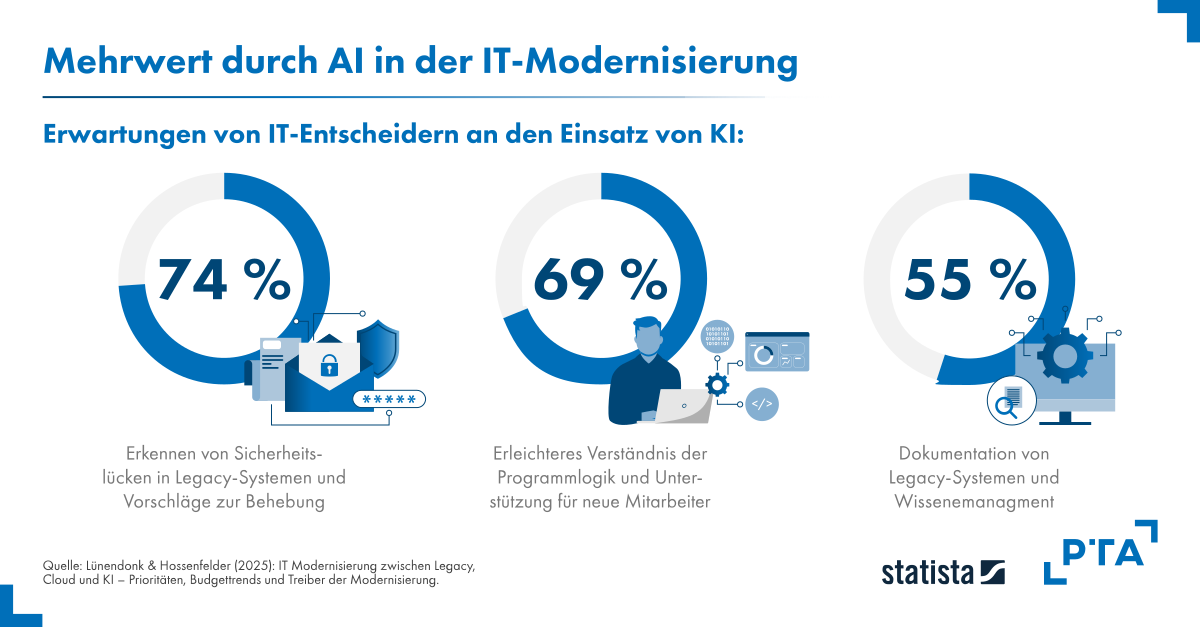
Our survey on Agentic AI shows where the specific problems lie: security/data protection (51%), technical hurdles such as data integration and infrastructure (50%), costs (45.5%) and skills shortages/know-how gaps (38.5%). These findings are typical for brownfield IT: distributed data, heterogeneous interfaces, little capacity for conversion.⁵
This is exactly where Agentic AI can come in: With Retrieval Augmented Generation (RAG), for example, AI agents dynamically access internal data sources, combine information from documents, databases or logs and make it usable for decisions.⁴ Multi-agent orchestration enables specialized agents to work together – for data retrieval, checking, booking or compliance, for example. They can be linked to existing automation solutions. The result: an end-to-end process that is traceable, logged and provides for clear approvals.6,7
How does Agentic AI work?

Computer-use capabilities close the gap when no API exists: Agents operate desktop and web interfaces like a human (clicking, typing, filling out forms), freeing up time for routine tasks. Ideal for legacy software that needs to keep running.8,9
Legacy systems will be with companies for a long time to come – but they don’t have to be an obstacle. With Agentic AI as a bridging technology, processes can be integrated, automated and modernized step by step. Those who set up an agent-capable integration layer now will gain time, quality and flexibility for the next modernization steps.
¹ Bitkom Research (2025): Digitization of the economy 2025 – Status, hurdles and self-image of companies
² Computerwoche/CIO/CSO (2024): Legacy modernization 2024 – 56% still use mainframes/midrange; one third run legacy for critical tasks
³ Lünendonk & Hossenfelder (2025): IT modernization between legacy, cloud and AI – priorities, budget trends and drivers of modernization
⁴ NVIDIA Developer (2025): Traditional RAG vs. Agentic RAG-Why AI Agents Need Dynamic Knowledge – RAG as a knowledge/integration layer for agents
⁵ PTA/Statista Research (2025): Own survey, n = 200 – Hurdles to the introduction of agentic AI (security/data protection, integration, costs, skills)
⁶ IBM watsonx OrchestrateMulti Agent Orchestration – Agents collaborate, share context and control workflows
⁷ PTA blog series (2025): Agentic AI: Companies of all sizes see high potential – Classification in Strategy & Operations
⁸ Microsoft Copilot Studio Docs (2025): Computer Use – GUI Interaction through Computer Using Agents (Preview)
⁹ The Verge / Reuters (2024): Introducing computer use and autonomous co-pilot agents for enterprise workloads